

Lower bills. Lights on
when the grid isn't.
Solar sized to your actual usage, batteries sized to what you need to keep running through an outage — specified for hurricane wind loads and salt air. No online estimator; real numbers after we see your bill.
Three problems, one honest conversation.
Replace utility kilowatt-hours with your own
We size systems to your last 12 months of usage, your roof and your utility's rules — not to a sales quota. Sometimes the right answer is a smaller system than you were quoted elsewhere.
Keep the AC, fridge and Wi-Fi running
Batteries with the right transfer switching keep essential circuits — or the whole house — up when the grid drops. Whole-home vs. essential-loads is a real decision; we'll walk you through it.
Advice from people who live here
We're a small local firm. You talk to a technical advisor, not a closer. Written design and economics before you sign anything, and a licensed contractor's name on the contract.
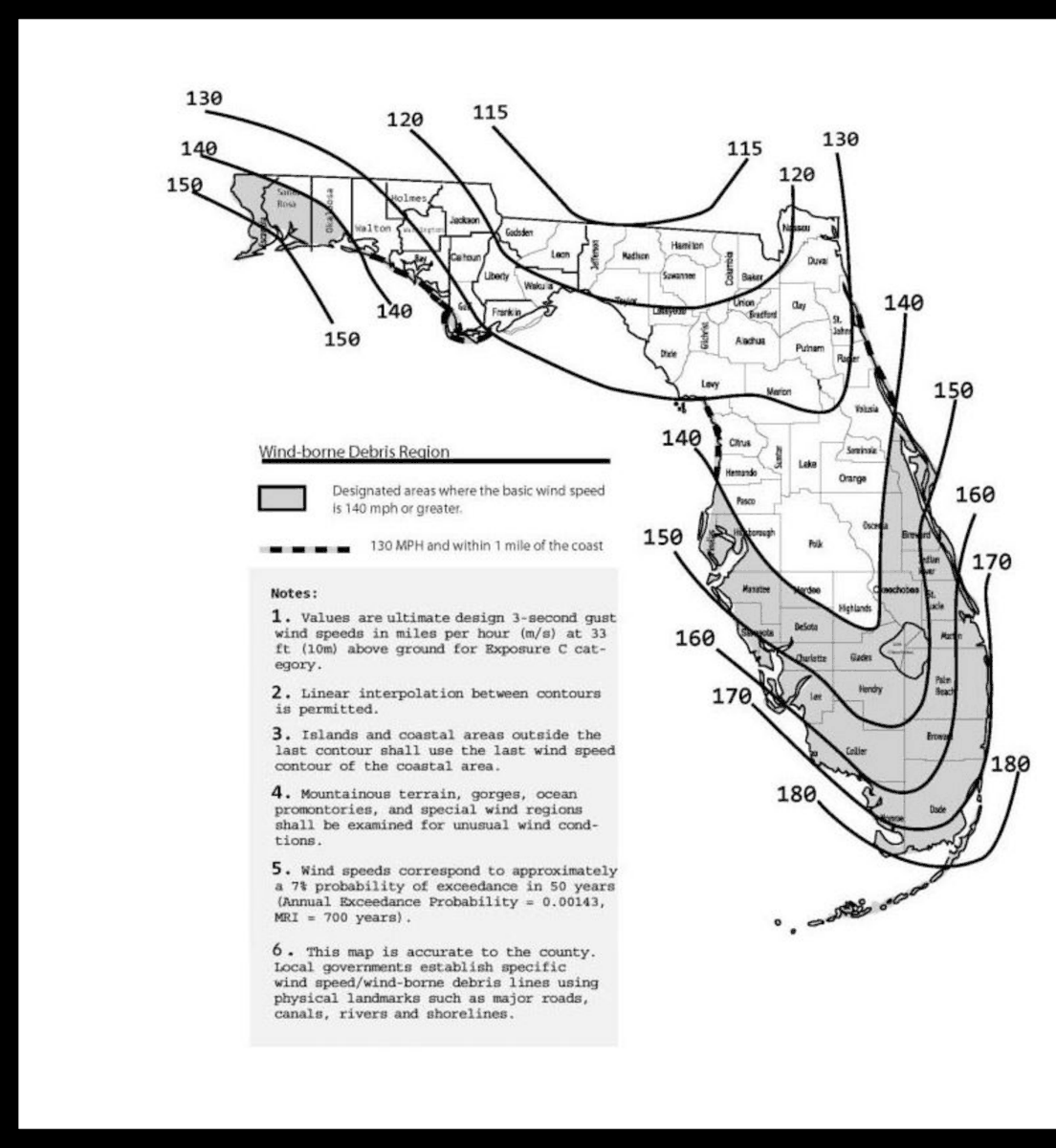
Salt air and 160-to-180-mph design winds are not optional considerations.
The Florida Building Code's wind map puts the state's southeast coast — Palm Beach, Broward and Miami-Dade — in the 160 to 180 mph ultimate design wind speed band, the most demanding in the state, and inside the Wind-Borne Debris Region. Every panel, rail, fastener and attachment on a Florida roof is engineered and permitted to that number. That is the single biggest reason a coastal Florida install is not the same job as one in Ohio, and why we specify for it instead of around it.
- Corrosion-rated racking and hardware for barrier-island and near-shore homes
- Wind-load engineering to your county's design speed, stamped by the contractor's engineer
- Battery placement that respects flood zone and setback rules
- Rapid shutdown, monitoring and warranty registration handled at commissioning
The floor on the base portion of every residential FPL bill, solar or not. Fuel charges, cost-recovery clauses, taxes and fees sit on top of it.
Source: FPL Residential Rates and Clauses, effective September 2026 · FPL minimum base bill explainer
Why a solar home in FPL territory still gets a bill.
Anyone who promises you a $0 FPL bill is either not reading the tariff or hoping you won't. FPL charges a minimum base bill — currently $30 a month for residential service — that covers the fixed cost of the poles, wires and meter that connect your home to the grid. It applies whether you use one kilowatt-hour or none.
- What solar does eliminate: the energy you would otherwise buy. A well-sized system can offset most or all of your kilowatt-hour charges over a year.
- What it doesn't: the minimum base bill, plus the fuel, storm and other clause charges and taxes that are calculated on whatever you still pull from the grid.
- What that means for design: we size to your real usage and the tariff you're actually on, so the system pays off on the bill you will really get — not a fantasy one.
Not an FPL customer? Other Florida utilities have their own minimum or customer charges. We'll show you yours before you decide anything.
Homeowner questions.
Why won't you give me a price online?
Because we'd have to guess at your roof, shading, usage and utility rules, and the tax treatment of a residential system depends on your personal situation. A number that's off by 30% helps nobody. Start your bill review; we'll send real numbers in writing.
Will my FPL bill go to zero?
No. FPL's tariff sets a $30 monthly minimum base bill for residential customers, and fuel, clause charges and taxes are added on top of whatever energy you still buy. Solar can remove most or all of the energy charges; it does not remove the connection. We design to the bill you'll actually receive.
What about the federal tax credit?
Federal incentive rules for residential solar changed materially with 2025 legislation, and eligibility depends on timing and your tax situation. We'll tell you exactly what applies to your project at the time you sign, and we recommend confirming with your tax professional. We don't quote incentive amounts on this site because they go stale.
Do I need a battery?
Not necessarily. If your goal is bill reduction alone, sometimes not. If your goal is riding through outages, yes — and the sizing question is which loads for how long. Our Batteries 101 page walks through it.
Who installs it?
An independent, state-licensed Florida contractor we partner with. Islander Solar handles design, equipment selection and project coordination; the contractor performs the installation, electrical work and permitting under its license.
A recent electric bill. Your address. Ten minutes on the phone.
That's enough for a written first pass on system size, battery options and rough economics.
Start your bill review. Get real numbers.
Free written review, a technical advisor within 24 hours, and no pressure to move faster than you want to.
Get my free bill review